Search This Blog

Wednesday, 30 August 2017

Supply and Demand Issues mean Maidstone Property Values Rise by 4.4% in the Last 12 Months

The most recent set of data from the Land Registry has stated that property values in Maidstone and the surrounding area were 4.4% higher than 12 months ago and 17.91% higher than January 2015.

Despite the uncertainty over Brexit as Maidstone (and most of the UK’s) property values continue their medium and long-term upward trajectory. As economics is about supply and demand, the story behind the Maidstone property market can also be seen from those two sides of the story.

Looking at the supply issues of the Maidstone property market, putting aside the short-term dearth of property on the market, one of the main reasons of this sustained house price growth has been down to of the lack of building new homes.

The draconian planning laws, that over the last 70 years (starting with The Town and Country Planning Act 1947) has meant the amount of land built on in the UK today, only stands at 1.8% (no, that’s not a typo – its one point eight percent) and that is made up of 1.1% with residential property and 0.7% for commercial property. Now I am not advocating building modern ugly carbuncles and high-rise flats in the Cotswolds, nor blot the landscape with the building of massive out of place ugly 1,000 home housing estates around the beautiful countryside of such villages as Hunton, Hollingbourne and East Farleigh.

The facts are, with the restrictions on building homes for people to live in, because of these 70-year-old restrictive planning regulations, homes that the youngsters of Maidstone badly need, aren’t being built. Adding fuel to that fire, there has been a large dose of nimby-ism and landowners deliberately sitting on land, which has kept land values high and from that keeps house prices high.

Looking at the demand side of the equation, one might have thought property values would drop because of Brexit and buyers uncertainty. However, certain commenters now believe property values might rise because of Brexit. Many people are risk adverse, especially with their hard-earned savings. The stock market is at an all-time high (ready to pop again?) and many people don’t trust the money markets. The thing about property is its tangible, bricks and mortar, you can touch it and you can easily understand it.  

The Brits have historically put their faith in bricks and mortar, which they expect to rise in value, in numerical terms, at least. Nationally, the value of property has risen by 635.4% since 1984 whilst the stock market has risen by a very similar 593.1%. However, the stock market has had a roller coaster of a ride to get to those figures. For example, in the dot com bubble of the early 2000’s, the FTSE100 dropped 126.3% in two years and it dropped again by 44.6% in 9 months in 2007… the worst drop Maidstone saw in property values was just 20.05% in the 2008/9 credit crunch.


Despite the slowdown in the rate of annual property value growth in Maidstone to the current 4.4%, from the heady days of 13.39% annual increases seen in mid 2010, it can be argued the headline rate of Maidstone property price inflation is holding up well, especially with the squeeze on real incomes, new taxation rules for landlords and the slight ambiguity around Brexit. With mortgage rates at an all-time low and tumbling unemployment, all these factors are largely continuing to help support property values in Maidstone (and the UK).

Monday, 7 August 2017

The Maidstone Property Market, The Beatles, Sweden and 50 year mortgages


50 years ago, in 1967, the first human heart transplant was performed by Dr Christian Barnard in South Africa. In the same year Sweden switched from driving on the left-hand side to the right-hand side of the road. 

The average value of a Maidstone property was £4,512, interest rates were at 5.5% and The Beatles released one of my favourite albums – their Sgt Peppers album ... but what the hell has that to do with the Maidstone property market today?? Quite a lot actually ... so with my CD Player turned up loud - let me explain my friends!

I have been doing some research on the current attitude of Maidstone first-time buyers. 

First-time buyers are so important for both landlords and homeowners. If first-time buyers aren’t buying, they still need a roof over their heads, so they rent (good news for landlords). 

The average value of a Maidstone property is currently standing at £340,223 and UK interest rates at 0.25%. 

As each year goes by, it appears the age of the everlasting mortgage has started to emerge, prompted by these first-time buyers, eager to get a foot on the housing ladder. 

I was reading a report a few days ago where some mortgage companies con-fessed that the battle to gain big returns from the property market has led to mortgages that will take considerably longer than the customary 25 years to pay off.

Over the last few years, it has been commonplace for first-time buyer mortgages to be 30 and 35 years in length as the ‘Bank of Mum and Dad’ have been helping with the deposit (Beatles Sgt Pepper song - “With a Little Help from My Friends”). Now, some high street banks are offering mortgage terms of 40 years. 

This means first-time buyers could be paying until their mid 60’s - I can hear that other great track from the same album "When I'm Sixty-Four" ring-ing in my ears! So, a 50-year mortgage does not seem as far-fetched now as it would have been back in the 1970’s. After all life expectancy for a male then was exactly 69 years and today its 79 years and 5 months!

Over the last ten years, Maidstone property prices have continued to rise more than wages, therefore, first-time buyers are looking for bigger loans. If this development continues, the only way repayments can remain reasonable is by increasing the term of the loan.


However, some commenters have said there are worries the mortgage companies are lending money over such a long term, they threaten leaving some first-time buyers with a generation of debt if the house price bubble bursts. Interestingly, when I looked at what had happened to average property values in Maidstone over the last 50 years, there have been bubbles. 

First-time buyers should take heart, since as a county we have always recovered from it a few years later.

What if interest rates rise? Well looking at historic UK interest rates, the current rate of 0.25% is at a 300-year low. Mortgages will never be cheaper. I would however, seriously consider fixing the rate to cushion any future potential interest rate rises (since they can only go in one direction when they do change). If Maidstone first-time buyers see buying a home as a long-term decision, based on the last 50 years, they should be just fine!


Before I go, a final thought for property buyers in Sweden, the land of Volvo and Abba. 

As Swedish property prices are so high, Swedish Regulators announced last year limits on the length of Swedish mortgage terms. They don’t bother with 50-year mortgages (On and On and On – Abba).

No, our Volvo-loving Swedish friend’s average mortgage length is 140 years (this is not a typo). 

Although such mortgages have had their Waterloo (Abba), regulators have significantly reduced the maximum term of a Swedish mortgage to 105 years.

Either way, that’s a lot of Money, Money, Money (Abba again – Sorry!) to pay back!

Now I will leave you in peace as I listen to the 1980’s Madness song ‘Our House’. My apologies to all the Beatles and Abba fans in Maidstone - a bit of light hearted fun albeit on serious topic.


1 in 8 Maidstone Properties are Leasehold


There are 23.36 million properties in England and Wales with 64% being owner occupied and 36% being rented either from a private landlord, local authority or housing association.

Over nine out of ten of those English and Welsh owner-occupied properties are a whole house or bungalow. Now, most people would assume they would be freehold - however, of those renting nearly half of rental properties, 44% to be precise, lived in other leasehold apartments and flats.

It might be wise to quickly explain the difference between free-hold and leasehold. When someone owns the freehold of a property they own it outright, including the land it is built on, whilst with a leasehold property the leaseholder owns the property for the length of their lease agreement. Leaseholders must pay the person who owns land (the freeholder) ground rent and other fees. When the leasehold ends, ownership re-turns to the freeholder although the leaseholder can extend the lease or they can buy the freeholder out, but there are rules and regulations with regards doing that.

Therefore, it would be safe to assume that houses are freehold and flats are leasehold .. wouldn’t it? Not necessarily! Most houses are freehold but some might be leasehold - usually through shared-ownership schemes – but more and more new homes builders are selling houses on a leasehold as well. The protection of the law afforded to leaseholders who own a flat is massive, but sadly lacking to leasehold houses sold privately.

Looking specifically at the figures for Maidstone, at the last  count in ME14-ME16 there were 49,329 properties. Since 1995, 45,946 properties in ME14-ME16 have changed hands and have been sold. Looking further at those 45,946 transactions
in ME14-ME16 since 1995, using data from Land Registry and solicitors practice My Home Move,11.99% have been leasehold (lower than the national average of 15%).

However, I am concerned about a few new homes builders selling new houses (not flats - houses) as leasehold. There has been a growing (yet small) trend for new-build houses to be sold as leasehold in recent years. While not all house builders use this model, those that do maintain it helps make developments financially viable. 

The issue comes when builders sell the freehold separately to an investment company without informing the lease holder – which they are legally allowed to do without telling the leaseholder. In England and Wales, the "right of first refusal" to buy the freehold is written in law to leaseholders of flats i.e. the freeholder must offer it to the leaseholders of all the flats of the building first), but not leaseholders of houses. .. and this is the point I am trying to get across. If you are buying a new home and it’s a house (i.e. not a flat) – please check very carefully indeed whether its freehold or leasehold. 

If it is a leasehold, whilst you do have rights, they are not as strong as for those people buying a leasehold flat. I appreciate I am only talking about a very small percentage of the property market, but potentially this could end up costing ......


Thursday, 3 August 2017

Maidstone Property Market and Mysterious Politics of the General Election

As the dust starts to settle on the various unread General Election party manifestos, with their ‘bran-bucket’ made up numbers, life goes back to normal as political rhetoric on social media is replaced with pictures of cats and people’s lunch.  Joking aside though, all the political parties promised so much on the housing front in their manifestos, should they be elected at the General Election.  In hindsight, irrespective of which party, they seldom deliver on those promises.
Housing has always been the Cinderella issue at General Elections.  Policing, NHS, Education, Tax and Pensions etc., are always headline grabbing stuff and always seem to go ‘the ball’. However, housing, which affects all our lives, always seems to get left behind and forgotten.

One policy that comes to mind is Margaret Thatcher’s Council House sell off in the 1980’s, when around 1.4m council houses went from public ownership to private ownership.  It was a great vote winner at the time (it helped her win three General Elections in a row) but it has meant the current generation of 20 somethings in Maidstone (and elsewhere in the Country) don’t have that option of going into a council house.  This has been a huge contributing factor in the rise of the private renting and buy to let in Maidstone over the last 15 years.

 Nevertheless, looking back to the start of the Millennium, Labour set the national target for new house building at 200,000 new homes a year (and at one point that increased to 240,000 under Gordon Brown for a couple of years).  In terms of what was actually built, the figures did rise in the mid Noughties from 186,000 properties built in 2004 to an impressive 224,000 in 2007 (the highest since the early 1980’s) as the economy grew.

Then the Credit Crunch hit.  It is interesting, that the 2010 Cameron/Clegg government did things a little differently.  The fallout of the Credit Crunch meant a lot less homes were built, so instead of tackling that head on, the coalition side-stepped the target of the number of new homes to build and offered a £400m fund to help kick start the housing market (a figure that was a drop in the ocean when you consider an average UK property was worth around £230,000 in 2010).  The number of new houses being completed dipped from 146,800 in 2011 to 135,500 the subsequent year.
So, one might ask exactly how many new homes do we need to build per year?  It is commonly accepted that not enough new properties are being built to meet the rising need for homes to live in.  A report by the Government in 2016, showed that on average 210,000 net additional households will be formed each year) up to 2039 (through increased birth rates, immigration, people living longer, lifestyle (i.e. divorce) and people living by themselves more than 30 years ago).  In 2016, only 140,600 homes were built ... simply not enough!

 Looking at the numbers locally in Maidstone and the surrounding area, it is obvious to me, that we as an area, are not pulling our weight either when it comes to building new homes. Although in the 12 months up to the end of Q1 2017, 1,130 properties were built in the Maidstone District Council area, we may still need to do better.  Go back to 2007, that figure was 720, 10 years before that in 1997, 380 new homes and further back to 1988, 1,000 new homes were built.
Who knows if Teresa May’s Government will last the five years?  She will think she has bigger fish to fry with Brexit to get bogged down with housing issues.  But let me leave you with one final thought.


The conceivable rewards in providing a place to live for the public on a massive house building programme can be enormous, as previous Tory PM’s have found out.  Winston Churchill in 1951, asked his Minister for Housing (Harold Macmillan) if he could guarantee the construction of 300,000 new properties a year, he was notoriously told: “It is a gamble—it will make or mar your political career, but every humble home will bless your name if you succeed.”

Isn’t it interesting, that the Tories remained in power until 1964!  Mrs May will have to work out if she wants to be the heiress to Harold Macmillan or David Cameron?


Friday, 28 April 2017

How The Rented Sector Has Transformed The Property Market In Maidstone


The Maidstone housing market has gone through a sea change in the past decades with the Buy-to-Let (B-T-L) sector evolving as a key trend, for both Maidstone tenants and Maidstone landlords.

A few weeks ago, the Government released a White Paper on housing. I have had a chance now to digest the report and wish to offer my thoughts on the topic. It was interesting that the private rental sector played a major part in the future plans for housing. This is especially important for our growing Maidstone population.

In 1981, the population of the Maidstone Borough Council area stood at 130,800 and today it stands at 164,500.

Currently, the private rented (B-T-L) sector accounts for 15.9% of households in the town.  The Government want to assist people living in the houses and help the economy by encouraging the provision of quality homes, in a housing sector that has grown due to worldwide economic forces, pushing home ownership out of the reach of more and more people. Interestingly, when we look at the 1981 figures for homeownership, a different story is told.

66.94% Maidstone people owned their own home in 1981
22.25% Maidstone people rented from the Council or Housing Association in 1981
 and 10.81% Maidstone rented from a Private Landlord       

The significance of a suitable housing policy is vital to ensure suitable economic activity and create a vibrant place people want to live in. With the population of the  Maidstone area set to grow to 202,000 by 2037 – it is imperative that Maidstone Borough Council and Central Government all work actively together to ensure the residential property market doesn’t hold the area back, by encouraging the building and provision of quality homes for its inhabitants.

One idea the Government has proclaimed is a variety of measures aimed at encouraging the Build-to-Rent (B-T-R) sector (instead of the B-T-L sector). These include allowing local authorities to proactively plan for B-T-R schemes, and making it simpler for B-T-R developers to offer inexpensive private rented homes.

To do this, the government will invent a distinct affordable housing class for B-T-R, called ‘Affordable Private Rent’, which will oblige new homes builders to provide at least 1 in 5 of a new home developments at a 20% discount on open-market rents and three year tenancies for tenants. In return, the new homebuilders will get better planning assurances.

Private landlords will not be expected to offer discounts, nor offer 3-year tenancies – but it is something Maidstone landlords need to be aware of as there will be greater competition for tenants.

Over the last ten years, home ownership has not been a primary goal for young adults as the world has changed. These youngsters expect ‘on demand’ services from click and collect, Amazon, Dating Apps and TV with the likes of Netflix. Many Maidstone youngsters see that renting more than meets their accommodation needs, as it combines the freedom from a lifetime of property maintenance and financial obligations, making it an attractive lifestyle option.


Private rented housing in Maidstone, be it B-T-L or B-T-R, has the prospective to play a very positive role. 

If you are looking for an agent that is well established, professional andcommunicative, then contact us to find out how we can get the best out of your investment property.

Email me on claire.harvey@seekersmaidstone.co.uk or call on 01622 671878. If you are in the area, feel free to pop into the office – we are based on 53 High Street, Maidstone, ME14 1SY. There is plenty of free parking and the kettle is always on.

Don't forget to visit the links below to view back dated deals and Maidstone Property News.

LinkedIn, www.linkedin.com/in/claireharveyestateagent
Blog, http://maidstonepropertyblog.blogspot.com/
Facebook, https://www.facebook.com/SeekersHomesUK
Twitter, https://twitter.com/seekershomes
Website, http://www.seekershomes.co.uk/ 

Friday, 17 March 2017

Maidstone’s ‘Generation Trapped’ and the £9.05bn legacy

Last week, I wrote an article on the plight of the Maidstone 20 something’s often referred to by the press as ‘Generation Rent’. Attitudes to renting have certainly changed over the last twenty years and as my analysis suggested, this change is likely to be permanent. In the article, whilst a minority of this Generation Rent feel trapped, the majority don’t – making renting a choice not a predicament. The Royal Institution of Chartered Surveyors (RICS) predicted that the private rental sector is likely to grow substantially by 1.8m households across the UK in the next 8 years, with demand for rental property unlikely to slow and newly formed households continuing to choose the rental market as opposed to buying.

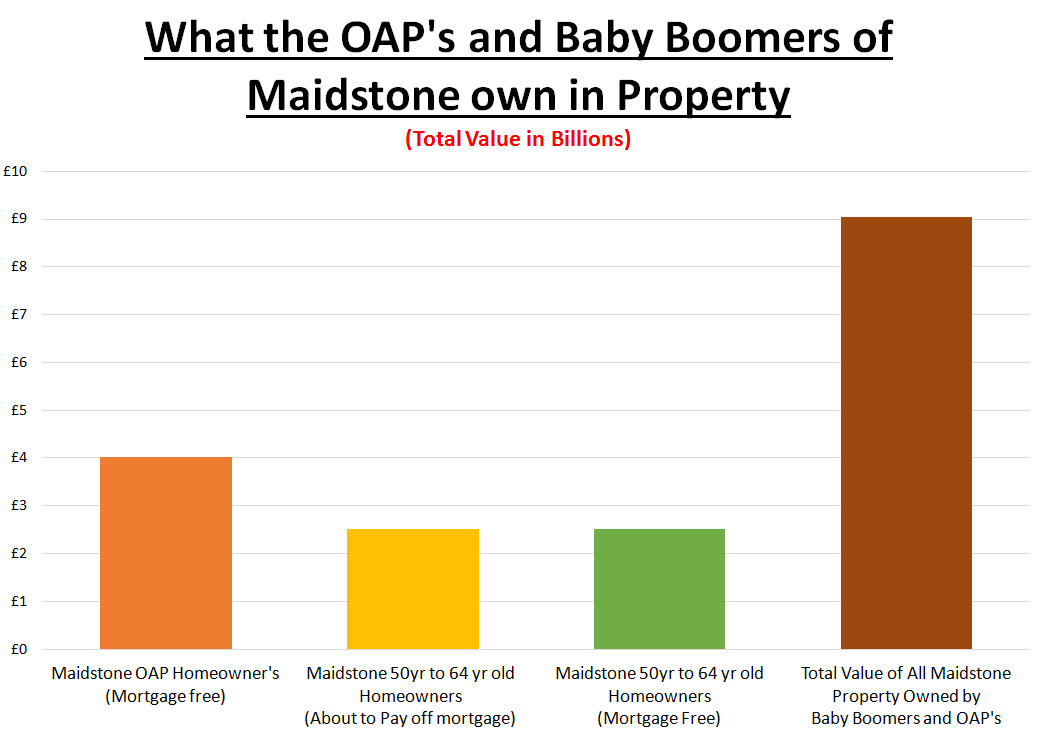
However, my real concern for Maidstone homeowners and Maidstone landlords alike, as I discussed a couple of months ago, is our mature members of the population of Maidstone. In that previous article, I stated that the current OAP’s (65+ yrs in age) in Maidstone were sitting on £4.01bn of residential property ... however, I didn’t talk in depth about the ‘Baby Boomers’, the 50yr to 64yr old Maidstone people and what their properties are worth – and more importantly, how the current state of affairs could be holding back those younger Generation Renters.

In Maidstone, there are 7,655 households whose owners are aged between 50yrs and 64yrs and about to pay their mortgage off. That property is worth, in today’s prices, £2.52bn. There are an additional 7,626 mortgage free Maidstone households, owned by 50yr to 64yr olds, worth £2.51bn in today’s prices, meaning...

Maidstone Baby Boomers and Maidstone OAP’s are sitting
on £9.05bn worth of Maidstone Property

These Maidstone Baby Boomers and OAP’s are sitting on 27,471 Maidstone properties and many of them feel trapped in their homes, and hence I have dubbed them ‘Generation Trapped’.

Recently, the English Housing Survey stated 49% of these properties owned by the Generation Trapped, as I have dubbed them, are ‘under-occupied’ (under-occupied classed as having at least two bedrooms more than needed). These houses could be better utilised by younger families, but research carried out by the Prudential suggest in Britain it’s estimated that only one in ten older people downsize while in the USA for example one in five do so.


The growing numbers of older homeowners who want to downsize their home are often put off by the difficulties of moving. The charity United for all Ages, suggested recently many are put off by the lack of housing options, 19% by the hassle and cost of moving, 14% by having to declutter their possessions and 14% by family reasons such as staying close to children and grandchildren.

Helping mature Maidstone (and the Country) homeowners to downsize at the right time will also enable younger Maidstone people to find the homes they need – meaning every generation wins, both young and old. However, to ensure downsizing works, as a Country, we need more choices for these ‘last time buyers’.


Theresa May and Philip Hammond can do their part and consider stamp duty tax breaks for downsizers, our local Council in Maidstone and the Planning Dept. should play their part, as should landlords and property investors to ensure Maidstone’s ‘Generation Trapped’ can find suitable property locally, close to friends, family and facilities.

If you are looking for an agent that is well established, professional andcommunicative, then contact us to find out how we can get the best out of your investment property.

Email me on claire.harvey@seekersmaidstone.co.uk or call on 01622 671878. If you are in the area, feel free to pop into the office – we are based on 53 High Street, Maidstone, ME14 1SY. There is plenty of free parking and the kettle is always on.

Don't forget to visit the links below to view back dated deals and Maidstone Property News.

LinkedIn, www.linkedin.com/in/claireharveyestateagent
Blog, http://maidstonepropertyblog.blogspot.com/
Facebook, https://www.facebook.com/SeekersHomesUK
Twitter, https://twitter.com/seekershomes
Website, http://www.seekershomes.co.uk/ 

Friday, 10 March 2017

‘Generation Rent (Forever)’ – 6,311 Maidstone Tenants have no intention of ever buying a property to call home


The good old days of the 1970’s and 1980’s eh … with such highlights lowlights as 24% inflation, 17% interest rates, 3 day working week, 13% unemployment, power cuts ... those were the days (not)… but at least people could afford to buy their own home. So why aren’t the 20 and 30 something’s buying in the same numbers as they were 30 or 40 years ago?

Many people blame the credit crunch and global recession of 2008, which had an enormous impact on the Maidstone (and UK) housing market. Predominantly, the 20 something first-time buyers who, confronting a problematic mortgage market, the perceived need for big deposits, reduced job security and declining disposable income, discovered it challenging to assemble the monetary means to get on to the Maidstone property ladder.

However, I would say there has been something else at play other than the issue of raising a deposit - having sufficient income and rising property prices in Maidstone. Whilst these are important factors and barriers to homeownership, I also believe there has been a generational change in attitudes towards home ownership in Maidstone (and in fact the rest of the Country).

Back in 2011, the Halifax did a survey of thousands of tenants and 19% of tenants said they had no plans to buy a home for themselves. A recent, almost identical survey of tenants, carried out by The Deposit Protection Service revealed, in late 2016, that figure had risen to 38.4%, with many no-longer equating home ownership to success and believing renting to be better suited to their lifestyle.

You see, I believe renting is a fundamental part of the housing sector, and a meaningful proportion of the younger adult members of the Maidstone population choose to be tenants as it better suits their plans and lifestyle. Local Government in Maidstone (including the planners – especially the planners), land owners and landlords need an adaptable Maidstone residential property sector that allows the diverse choices of these Maidstone 20 and 30 year olds to be met.

This means, if we applied the same percentages to the current 16,435 Maidstone tenants in their 7,008 private rental properties, 6,311 tenants have no plans to ever buy a property – good news for the landlords of those 2,691 properties. Interestingly, in the same report, just under two thirds (62%) of tenants said they didn’t expect to buy within the next year.

.. but does that mean the other third will be buying in Maidstone in the next 12 months?

Some will, but most won’t … in fact, the Royal Institution of Chartered Surveyors (RICS) predicts that, by 2025, that the number of people renting will increase, not drop. Yes, many tenants might hope to buy but the reality is different for the reasons set out above.  The RICS predicts the number of tenants looking to rent will increase by 1.8 million households by 2025, as rising house prices continue to make home ownership increasingly unaffordable for younger generations.  So, if we applied this rise to Maidstone, we will in fact need an additional 3,003 private rental properties over the next eight years (or 375 a year) … meaning the number of private rented properties in Maidstone is projected to rise to an eye watering 10,011 households.

For more insight and thoughts like this on the Maidstone Property Market – please visit the Maidstone Property Blog.

If you are looking for an agent that is well established, professional and communicative, then contact us to find out how we can get the best out of your investment property.

Email me on claire.harvey@seekersmaidstone.co.uk or call on 01622 671878. If you are in the area, feel free to pop into the office – we are based on 53 High Street, Maidstone, ME14 1SY. There is plenty of free parking and the kettle is always on.

Don't forget to visit the links below to view back dated deals and Maidstone Property News.

LinkedIn, www.linkedin.com/in/claireharveyestateagent
Blog, http://maidstonepropertyblog.blogspot.com/
Facebook, https://www.facebook.com/SeekersHomesUK
Twitter, https://twitter.com/seekershomes
Website, http://www.seekershomes.co.uk/